Technical Coating Guidance
Amine Blush & Amine Bloom – Why “Soap & Water” Isn’t Always Enough
Amine Blush & Amine Bloom – Why “Soap & Water” Isn’t Always Enough One of the most common recommendations I hear when amine blush or bloom is suspected is: “Just wash the surface with soap and water.” While effective in most cases, this method isn’t a universal solution and relying on it alone can lead to coating failures down the line. In my experience, removing amine blush or bloom isn’t always the same process, and the appropriate method depends on several factors: · The specific resin and curing agent · Environmental conditions during cure · Whether the issue is blush, bloom, or another surface contaminant Many coating manufacturers recommend soap and water. However, others specify water-based cleaning methods or alcohol/water mixtures in their surface preparation guidance. I have seen cases where soap and water alone did not effectively remove the blush; a mixture of isopropyl alcohol and water was required to eliminate it. One critical point that often gets overlooked: 👉 Do not abrade the surface before the blush or bloom is removed. Abrading first can drive the contaminant into the surface, making removal more difficult and increasing the risk of adhesion failure. Cleaning should always come first; abrading should only follow after the surface has been properly cleaned and verified. For that reason, my consistent recommendation is simple: Contact the coating manufacturer and follow their written instructions. Assuming one cleaning method works for all epoxy systems can create a false sense of surface cleanliness, and that’s often where coating failures begin.
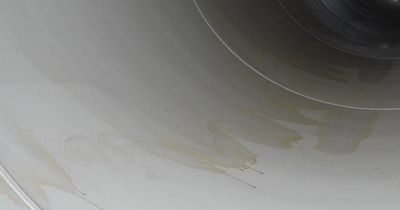
Amine Blush on Interior of Pipe
When Should You Use Accelerators in Polyurethane Finish Coats?
As cooler temperatures approach across the U.S. and Canada, applicators often face a common challenge: maintaining consistent curing and appearance in polyurethane finish coats. Some days may be warm, while others dip near or even below freezing. This raises a frequent question: when should you use an accelerator and when should you avoid it to prevent issues such as amine blush or coating failures?
Consistency Is Key
My standard answer is simple: if you decide to use an accelerator (or a particular solvent), it should be used consistently throughout the entire finish coat, not just on certain days.
Why? Because inconsistencies in how the material is modified can lead to noticeable differences in the final appearance, including problems like amine blush or uneven gloss. Even subtle changes in application conditions or additives can create visible shifts in color or surface texture.
Best Practice
To achieve a uniform finish coat with predictable performance and to avoid coating failures, avoid treating accelerators or solvents as "spot solutions" for daily weather changes. Instead, plan their use as part of the overall coating strategy for the project. This approach helps maintain consistency in both appearance and long-term performance.

Amine Blush vs. Bloom: What’s the Difference and Why It Matters
Epoxy coating failures are often attributed to "surface contamination," but it’s essential to distinguish between two commonly confused phenomena—amine blush and bloom. Misunderstanding these can lead to improper surface preparation, poor adhesion, and ultimately, coating failures.
Recognizing the difference is crucial when assessing epoxy performance, recoatability, and bond failures.
What Is Amine Blush?
Amine blush is a surface film that forms during the curing of certain amine-cured epoxies. This occurs due to a chemical reaction involving unreacted amines, carbon dioxide, and moisture in the air.
Key characteristics of amine blush include:
- Appearing as a waxy, greasy, or hazy film
- Often invisible until water is applied
- Water-soluble
- Forms most readily in cool, humid conditions
- Can develop within hours of application
Since amine blush sits on the surface, it can interfere with adhesion if additional coatings, such as polyurethane finish coats, are applied without proper removal.
Important: Solvents alone do not reliably eliminate amine blush. Water washing, often combined with light abrasion using cloths or brushes, is typically necessary.
What Is Bloom?
Bloom differs from amine blush; it is not a surface contaminant but rather a physical or chemical change within the cured epoxy itself.
Bloom typically occurs when:
- Epoxies cure at low temperatures
- The formulation includes certain plasticizers or additives
- Cure is incomplete or disrupted
Key characteristics of bloom are:
- Appearing as a whitish, cloudy, or milky discoloration
- Existing within the coating, not on the surface
- Not water-soluble
- Cannot be washed off
- Often permanent unless the coating is removed
While bloom may not always impact adhesion, it can indicate incomplete cure or compromised material properties, which is especially problematic in demanding environments.
When amine is present on the surface but does NOT react with water and CO₂, you are dealing with unreacted or migrated amine, not amine blush.
The correct way to think about it is:
- Amine blush = a reaction product
- Surface amine = a residual component
Amine blush only exists after the amine reacts with atmospheric CO₂ and moisture. If this reaction does not occur, blush does not exist.
What this condition actually is:
- Proper description: Surface-enriched amine, unreacted curing agent at the surface, amine migration/amine exudation.
This happens when amines migrate upward during cure or remain unconsumed due to stoichiometry, temperature, or cure interruption.
This unreacted amine must be removed before overcoating, or adhesion issues may arise.